Showing posts with label Creative kids Daycare in Surrey. Show all posts

Friday, 25 August 2023

What benefits of Montessori Preschool Surrey over other options?

Education is the cornerstone of a child's future, and the kind of preschool they attend can have a big impact on how they develop. For their distinctive approach to early childhood education, Montessori schools and Montessori childcare in surrey, a widely respected educational system, have won praise. In Surrey, a prospering community in British Columbia, Canada, Montessori preschool enrollment has increased.

The best preschool for a child should be chosen with great care. Montessori preschools in Surrey provide a method that skillfully combines rigorous academics with holistic development for parents. The Montessori approach stands out as an appealing choice for those looking to provide their children with a well-rounded foundation thanks to its emphasis on individualized learning, creativity, and life skills. 

Montessori childcare in surrey, Montessori Preschool in surrey, Montessori childcare near me

Let's talk about the benefits of Preschool:

1. Child-Centered Approach-

Traditional education often follows a one-size-fits-all approach. In contrast, Montessori education in Surrey tailors the learning environment to each child's unique abilities and interests. This means children learn at their own pace, fostering independence and confidence.

2. Hands-on Learning-

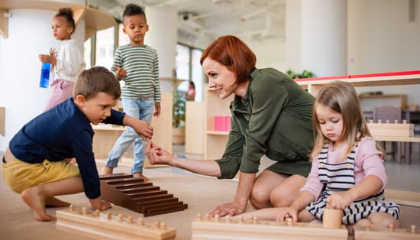
Montessori schools are renowned for their emphasis on tactile and experiential learning. Children in Surrey's Montessori preschools benefit from an array of hands-on materials designed to make abstract concepts tangible, ensuring a deeper understanding of topics.

3. Development of Life Skills-

Beyond academic prowess, Montessori preschools in Surrey emphasize life skills like responsibility, self-discipline, and respect for others. Tasks such as cleaning up after oneself or helping classmates instill a sense of community and personal responsibility.

4. Fostering Creativity-

While some traditional preschools might prioritize rote learning, Montessori schools in Surrey encourage children to think outside the box. Through open-ended activities and less restrictive guidelines, children's innate creativity flourishes.

5. Holistic Development-

Montessori education considers the child's cognitive, emotional, and social development. Hence Surrey's Montessori preschools thus focus not only on academic achievements but also on nurturing emotional intelligence and social skills.

6. Preparation for Future Learning-

Therefore The skills acquired in a Montessori setting—like self-directed learning and critical thinking—lay a solid foundation for future educational endeavors. Hence This means children from Montessori preschools in Surrey are often well-prepared for the demands of subsequent schooling.

7. Diverse and Inclusive-

Therefore Many Montessori schools in Surrey pride themselves on embracing diverse student populations, ensuring that children learn in an environment that respects and celebrates differences.

8. Connection with Nature-

Therefore Given Surrey's lush landscapes and emphasis on environmental stewardship, many Montessori preschools in the area integrate nature-based learning. Moreover, This not only instills an appreciation for the environment but also offers practical lessons on biology, ecology, and the sciences.

9. Community Engagement-

Therefore Montessori preschools in Surrey often emphasize community engagement, fostering a sense of belonging and responsibility towards the larger community. Field trips, community projects, and collaborative events are common features.

Importance of Preschool for Child:

The preschool serves as a smooth introduction to life outside of the safety and comfort of the home for young children. Preschool is important for many reasons other than merely serving as a transitional period before primary school Also Montessori Preschool in surrey is one the best choices for you.

Therefore A child's educational journey must include a crucial stage called preschool, which provides much more than merely academic preparation. It molds fundamental skills, instills values, and shapes character. Hence Children learn about themselves and the world around them in the loving environment of a preschool, laying the groundwork for a lifetime of learning and development.

Final Thoughts:

Selecting a Surrey Montessori Preschool offers a distinctive and beneficial approach to early childhood education. A holistic learning environment that addresses not just academic but also emotional, social, and physical growth is provided by this approach. Moreover, it is based on individualized learning and prioritizes the child's natural pace and interests. There are many organizations where you can search Montessori childcare near me.

Kidzville Learning Center provides a nurturing and stimulating environment where children can learn, play, and develop crucial skills needed for their future schooling and life. We are focused on holistic development, integrating cognitive, social, emotional, and physical activities into the daily routine.


Tuesday, 8 August 2023

Early brain development and health of toddlers

The earliest years of a child's life are characterized by rapid brain development and an incredible capacity for learning. The foundation like toddler montessori in surrey laid during these formative years has a profound impact on a toddler's immediate well-being, setting the stage for future health, learning, and behavior. Understanding the complexities of early brain development provides valuable insights into promoting optimal health and well-being in toddlers.

The health and development of a toddler's brain is influenced by many factors, including nutrition, sleep, physical activity, and the quality of their experiences and interactions. By understanding and supporting these critical aspects, we can lay the foundation for each child's future healthy growth, learning, and overall well-being.

Here are the key factors:

1. A Glimpse into Brain Development

By the time a baby is born, their brain contains nearly all the neurons they'll ever have. However, the connections between these neurons, known as synapses, multiply at an astonishing pace during the first few years. In fact, by age three, a child's brain has formed a trillion synapses, twice as many as an adult’s.

2. The Significance of Early Experiences

The "serve and return" contact between children and their caretakers shapes the architecture of the brain. Neural connections are formed and strengthened in the child's brain that assist the growth of communication and social skills when an adult appropriately reacts to an infant or toddler's babble, gestures, or screams with eye contact, words, or a hug.

Negative experiences, like chronic neglect or exposure to violence, can be harmful to brain development. Such stress can activate the body's stress response, and without the buffering presence of a supportive adult, can lead to a condition known as "toxic stress". Over time, toxic stress can impair the connection-building process, leading to lifelong problems in learning, behavior, and overall health.

3. The Role of Nutrition

Proper nutrition during the toddler years is crucial for brain development. Essential nutrients such as iron, zinc, and omega-3 fatty acids play pivotal roles. Iron, for example, is crucial for cognitive, motor, and behavioral development. A deficiency can lead to delays in these areas. Omega-3 fatty acids, particularly DHA, support the development of the cerebral cortex, the part of the brain responsible for memory, language, and creativity.

4. Importance of Sleep

Sleep is more than just a period of rest. In the consolidation of memory and learning, it is crucial. The brain organizes and processes the day's information as you sleep. Toddlers' attention, memory, and emotional regulation can be strengthened by regular naps and a regular bedtime.

5. Physical Activity and Brain Health

Physical activity promotes the development of motor skills and encourages exploration, both of which are fundamental for cognitive development. As toddlers move and interact with their environment, they form new neural connections that support various areas of development, including problem-solving and social interaction.

6. Encouraging a Stimulating Environment

To boost brain development, toddlers should be exposed to a variety of experiences. Simple activities like reading books, playing with blocks, singing songs, and even engaging in imaginative play can significantly stimulate a toddler's brain.

7. Establishing Secure Attachments

Building a strong, trusting relationship with caregivers is crucial for a toddler’s emotional and cognitive health. Secure attachments provide a foundation from which toddlers can explore the world, confident in the knowledge that they can return to a safe base. These attachments foster self-esteem, resilience, and better outcomes in social and cognitive domains later in life.

Importance of brain development of toddlers:

The toddler years, usually between the ages of 1 and 3, represent an incredibly dynamic time in a child's life. During this time, the brain undergoes rapid and extensive development that affects many areas of the child's life. Understanding the importance of this stage is crucial for carers, educators, and policymakers alike.

1. Foundation for Future Learning:

During the toddler years, the brain forms a vast number of synapses or connections between neurons. These synapses are the basis for all future learning and cognition. A strong foundation in these early years ensures that later learning can be built upon a solid base.

2. Development of Core Skills:

Basic skills such as attention, memory, and language comprehension start to flourish during this time. Mastery of these core cognitive skills in the toddler years sets the stage for more complex skill acquisition in later years.

3. Emotional and Social Growth:

As toddlers interact with their environment and caregivers, they begin to understand emotions, develop empathy, and establish their first social relationships. These early experiences shape their future emotional intelligence and ability to form healthy relationships.

4. Formation of Habits and Behaviors:

Brain development during the toddler years is closely tied to the establishment of routines, habits, and behaviors. These patterns, once ingrained, can influence a child’s behaviors and habits well into adulthood.

5. Critical Periods for Sensory Development:

Certain sensory systems, like vision and hearing, have critical periods during which the brain is especially receptive to external stimuli. Optimal development during these periods is vital for normal sensory function.

6. Influence of External Environment:

The plasticity, or adaptability, of a toddler's brain, means it is highly sensitive to the environment. This underscores the importance of providing positive, enriching experiences, as negative ones can have lasting detrimental effects.

7. Resilience and Adaptability:

The high plasticity of the toddler's brain not only means it's sensitive to environmental factors but also that it has a tremendous capacity for recovery. Early interventions for developmental delays or disorders can harness this plasticity, resulting in better outcomes than interventions later in life.

8. Foundation for Moral and Ethical Behavior:

During the toddler years, children start to develop a basic sense of right and wrong. Experiences during this time can influence their moral and ethical compass in the future.

9. Language Acquisition:

While infants begin the process of language acquisition, it’s during the toddler years that vocabulary expands rapidly and grammatical rules are internalization. The foundation for language skills, essential for communication and future academic success, is established during this period.

10. Setting Health Trajectories:

The brain's development is closely intertwined with other systems in the body. Proper brain development can set the course for good physical and mental health throughout life.

Final Thoughts:

Early brain development is a profound and complex process that significantly affects a toddler's health, well-being, and future abilities. The experiences, interactions, and environments preschool in Surrey provide during these formative years lay the foundation for a myriad of cognitive, emotional, and physical outcomes.

ecadema’s aim is to provide a nurturing and stimulating environment where children can learn, play, and develop crucial skills needed for their future schooling. Hence We are focused on holistic development, integrating cognitive, social, emotional, and physical activities into the daily routine.

Saturday, 29 July 2023

Why is preschool important for children?

Preschool education, often referred to as early childhood education, provides children at Montessori Preschool in surrey with an initial platform for the transition to the world of education. But beyond the fact that kindergarten is just before primary school, it has many benefits, both academically and socially. 

Kindergarten is the foundation of your child's future education and success. The introduction of daily activities, group discussions, and skills not only facilitates the transition to school but also enables children to begin their learning journey with confidence and enthusiasm. hence Parents, teachers, and policymakers should recognize and support the great benefits that early childhood education has to ensure that all children have the opportunity to start their education the right way.

Here are the key factors:

1. Provide a foundation for learning skills

One of the biggest benefits of kindergarten is the importance of basic skills. Here children will learn numbers, letters, and simple shapes. hence While these may seem simple, children's knowledge of these concepts lays the foundation for a deeper understanding in the years to come.

2. Social and Emotional Development

Hence Kindergarten provides many children with the first important opportunity to interact with their peers in a formal setting. Moreover, Through games and group activities, children learn to share, collaborate, change, and solve problems. The foundation of good relationships is important for future teamwork inside and outside the classroom.

3. Learning through play

Many kindergarten programs are based on learning through play. This approach recognizes children's curiosity and interests and uses them as learning tools. Hence Through play, children not only have fun, but also develop critical thinking, problem-solving, and motor skills.

4. Build independence

Moreover, For many children, kindergarten is their first time away from their primary caregivers. Although this separation may be difficult at first, it can encourage independence.

hence Children learn to trust other adults, manage their own belongings, and even do chores like washing their hands and eating snacks on their own.

5. The teaching process

Therefore Although many children have homework, preschoolers introduce them to an environment where they alternate between different activities at certain times. hence This will help them adjust to the stricter schedule of primary school.

6. Promote Physical Development

therefore Besides cognitive development, preschool offers many opportunities for physical development. hence Through physical education, outdoor free play, or indoor play, children develop their motor skills and fine motor skills in this environment.

7. Promote curiosity and interest in learning

A suitable environment for children can foster a love of learning. Therefore The importance of exploring and discovering in kindergarten can create a positive atmosphere in a child's learning and Hence encourage them to take an interest in learning throughout their academic career.

8. Preparing for Kindergarten

Moreover, Kindergarten helps prepare children for everyday life and the expectations of kindergarten, as well as learning skills and social skills. Hence This transition can reduce stress and lay the groundwork for the transition to formal education.

Impact of preschool on children's lives:

1. Academic Head Start:

Kindergarten provides early exposure to reading, math, and science concepts. This foundation allows them to enter school regularly with an understanding of key academic concepts, making the transition to kindergarten and beyond.

2. Social-Emotional Development:

Communication with friends in the educational environment helps children's intellectual-emotional development.

They learn to empathize, how to express emotions, and build self-confidence. These early emotional lessons are important for coping with social and emotional challenges later in life.

3. Cognitive Development:

Therefore Preschoolers develop problem-solving skills, critical thinking, and intelligence through games and activities. Hence These skills are important not only academically, but also in making everyday decisions in life.

4. Develop adaptability and adaptability:

Therefore Kindergarten often teaches children the first time they fail, whether it's failing to complete a challenge or getting into conflict with friends. Hence Under the guidance of teachers, children learn to be strong, to be strong, and to know that mistakes are opportunities for growth.

5. Appreciate diversity:

In many preschool settings, children meet friends from different cultures. Hence This early exposure develops an appreciation for diversity, culture, and thought, creating an open-minded future population.

Final Thoughts:

Preschool is an integral part of homeschooling and homeschooling, gradually introducing children to academic concepts, daily activities, and classroom relationships and well you can search preschool near me. It supports their cognitive, social, emotional, and physical development by providing a safe and supportive environment for children to explore, play and learn.

Ecadema’s aim is to provide a nurturing and stimulating environment where children can learn, play, and develop crucial skills needed for their future schooling. Hence We are focused on holistic development, integrating cognitive, social, emotional, and physical activities into the daily routine.


Thursday, 20 July 2023

What is the process of developing creative skills in your toddler?

Creative intelligence underlies many important intellectual, social, and emotional skills and toddler montessori in surrey. Developing these abilities early can lay the foundation for a love of exploration, innovation, and problem-solving. Hence The fact that children are always curious and curious gives this development a good start.

Therefore It is about fostering children's creativity, providing opportunities, evaluating their processes, and providing a safe space for exploration. hence By developing these skills early on, you will lay a foundation for lifelong thinking and problem-solving.

toddler montessori in surrey, full-time preschool in surrey, preschool in surrey, childcare center, infant toddlers in surrey

Here are the key factors:

1. Provide Open-Ended Materials-

Moreover, Give your toddler materials that have a variety of purposes. Therefore Items such as blocks, clay, crayons, paper, and fabric scraps allow them to create anything they can imagine.

2. Create a Safe and Stimulating Environment-

Therefore Ensure the play environment is safe for exploration. Moreover, This means toddler-proofing spaces and making sure they can access and use materials without constant fear of getting hurt.

3. Embrace the Mess-

Moreover, Creativity is often messy. It’s crucial to let your child experiment without the constant fear of making a mess. Therefore This encourages them to try new things.

4. Celebrate the Process, Not Just the Outcome-

Hence It’s easy to focus on the end product, but the creative journey is where real learning takes place. Moreover, Celebrate your child’s effort and process, even if it doesn't lead to a recognizable end product.

5. Limit Screen Time-

Moreover, While technology offers numerous educational benefits, passive screen time can hinder a child's creative development. Hence Ensure a balance between tech use and hands-on creative play.

6. Offer Choices-

Empower your toddler by giving them choices. Hence This promotes decision-making skills and boosts confidence.

7. Encourage Curiosity-

Therefore If your child asks a question, instead of giving them the answer right away, guide them to explore and find the answer on their own.

8. Engage in Play-

Therefore Join your toddler in their play. Hence Your participation not only strengthens your bond but also models creativity and problem-solving skills.

9. Expose Them to Different Experiences-

Visits to the zoo, museum, or even a simple walk in the park can provide new stimuli for creativity. Different environments, sounds, sights, and experiences fuel the imagination.

10. Read Together-

Stories are a gateway to different worlds. Reading together fosters a love for books and enhances imagination and creativity.

12. Value Their Ideas-

Listen to your toddler's ideas and thoughts without judgment. Hence This shows them that their ideas are valuable and encourages further creativity.

Importance of  creative skills in toddlers:

1. Cognitive Development-

Therefore Problem-Solving: When toddlers engage in creative activities, they often encounter challenges, like how to balance a block tower or mix colors to get a desired shade. hence Finding solutions to these issues enhances their problem-solving abilities.

2. Emotional Growth-

Moreover Self-expression: Creative activities provide toddlers with an avenue to express their feelings, thoughts, and experiences. Hence This can be especially important when they don't yet have the vocabulary to articulate complex emotions.

Building Confidence: Completing a drawing, building something with blocks, or even just experimenting with musical instruments can give toddlers a sense of accomplishment, boosting their self-confidence.

Coping Mechanism: Art and other creative outlets can serve as therapeutic tools, helping toddlers process feelings and navigate emotional challenges.

3. Social Skills-

Collaboration: Group creative activities, like group paintings or role-playing games, teach toddlers the value of teamwork, sharing, and understanding different perspectives.

Communication: Through sharing their creations and discussing them, toddlers can improve their communication skills and vocabulary.

4. Physical Development-

Fine Motor Skills: Activities like drawing, sculpting with clay, or threading beads help in refining fine motor skills which are vital for tasks like writing in the future.

Therefore Gross Motor Skills: Dancing, acting out stories, or large-scale art projects can improve their overall physical coordination.

Final Thoughts:

The process of developing children's creativity is a multi-faceted journey that includes taking time, creating the environment, and watching their unique expressions. Hence By providing open information, encouraging curiosity and exploration, and coping with the stress of creativity, caregivers can create a safe and nurturing environment for children.

The main aim is to provide a nurturing and stimulating environment where children can learn, play, and develop crucial skills needed for their future schooling and life well as they give you full-time preschool in surrey. Hence We are focused on holistic development, integrating cognitive, social, emotional, and physical activities into the daily routine.

Thursday, 1 June 2023

Infants and toddler steam concepts

The first year of life is an incredible journey of growth and development. Therefore  This period, commonly referred to as infancy, marks significant milestones as a child transitions from a helpless newborn into an active and curious toddler. Montessori Preschool in surrey is the perfect choice for you.

Moreover, It is a time when the foundations of physical and mental abilities, personality, and social relations are laid. As we understand more about these critical stages in an infant's life, we can better support their development and help set the stage for their future growth and learning. This article seeks to explore various aspects of infancy, including physical, cognitive, and socio-emotional development.


kidzville learning center, preschool in surrey, infant toddlers in surrey


The Importance of Early Steam Education:

Research suggests that the first few years of a child's life are critical for their cognitive, social, and emotional development. Moreover, During this time, children's brains develop at an unparalleled rate, making it an ideal period for introducing foundational STEAM concepts. Hence Early exposure to STEAM helps build problem-solving skills, fosters creativity, develops critical thinking, and instills a love for learning.  Moreover, Therefore It also helps prepare children for a future where these skills will be in high demand.

Integrating Steam into Everyday Activities:

Therefore The beauty of STEAM education for infants and toddlers is that it can be integrated seamlessly into everyday play and exploration.

Science-

Moreover, Infants and toddlers are natural scientists, constantly exploring the world around them. Encourage this by introducing different textures, colors, and sounds during playtime. Observe natural phenomena like rain, the growth of plants, or the change in seasons.

Technology-

Moreover, For this age group, technology doesn't refer to screens but to understanding cause and effect. This could involve simple machines like gears, wheels, or levers, and how they work. Toys that involve sorting, pushing buttons, or stacking can help with this understanding.

Engineering-

Moreover, Building with blocks, solving simple puzzles, or using objects for different purposes encourages engineering thinking. Even a toddler deciding to use a stool to reach something is beginning to think like an engineer!

Art-

Art plays a crucial role in enhancing creativity and expression. Allow children to engage in freeform painting, sculpting with clay, or making collages. Art is also an excellent medium for introducing patterns and geometry, integral components of STEAM education.

Mathematics-

Hence Early math skills can be developed through counting games, identifying shapes, or simple sorting activities. Everyday moments, like snack time or a walk in the park, offer opportunities to introduce concepts like 'more' or 'less', 'big', or 'small'.

The Role of Parents and Educators:

Hence Parents and educators play a crucial role in early STEAM education. It's important to provide opportunities for exploration and creativity, encourage curiosity, and allow children to learn at their own pace. Hence Asking open-ended questions, like 'What do you think will happen if...?' can stimulate critical thinking and problem-solving skills.

Therefore Remember, the goal isn't to produce toddler scientists or engineers but to create an environment that encourages curiosity, exploration, and creativity. Hence The benefits of early STEAM education will extend far beyond these early years, setting a strong foundation for future learning and success.

Final Thoughts:

Integrating STEAM concepts into the early learning journey of infants and toddlers is a highly effective way to promote cognitive development, foster curiosity, and instill a lifelong love for learning. It's not about making them miniature scientists or engineers.  So toddler montessori in Surrey can be a good choice for parents.

Kidzville Learning Centers is the leading platform for kids. If as a parent you're looking for the perfect learning point then this platform could be a nice choice for you. They help to develop their problem-solving skills, critical thinking, and creativity, which are fundamental skills for their future.


Wednesday, 10 May 2023

ECE and preschool teachers: what's the difference

Early childhood education (ECE) and preschool teaching are both crucial in laying the foundation for a child’s learning and development. While there may be some overlap between the two, there are also some significant differences. In this article, we’ll explore the differences between ECE and preschool teaching.

After a survey of preschools in Surrey ECE is a broad term that encompasses all forms of education that children receive before entering formal schooling. ECE can include activities such as play-based learning, storytelling, singing, and other interactive activities that help children develop their cognitive, social, emotional, and physical skills. ECE is typically for children aged 0 to 8 years old.


kidzvillelearningcenter, preschool, childcare center, ECE Teachers

Preschool Teaching:

Preschool teaching, on the other hand, is a more structured and formal type of education that focuses on preparing children for kindergarten and beyond. Preschools are typically for children aged 3 to 5 years old and are designed to provide a more structured learning environment.


Preschool teachers work with children to develop important academic skills such as math, language, and reading. They may also teach social skills, such as sharing, taking turns, and following instructions. Preschool teachers are responsible for developing lesson plans and ensuring that each child is making progress in their learning.

Differences between ECE and Preschool Teaching:

While there is some overlap between the two, the primary difference between ECE and preschool teaching is in the focus of the curriculum. ECE focuses on overall growth and development, while preschool teaching focuses on academic skills and preparing children for formal schooling.


ECE teachers use a range of activities to support children's development, including play-based learning and interactive activities. Preschool teachers, on the other hand, use a more structured curriculum to prepare children for formal schooling.


Another key difference is in the age range of the children. ECE is typically for children aged 0 to 8 years old, while preschool teaching is for children aged 3 to 5 years old.

The Importance of early literacy development in ECE:

Early literacy development is a crucial aspect of early childhood education (ECE) as it sets the foundation for lifelong learning. Early literacy involves developing the skills and knowledge needed to read and write, including phonological awareness, vocabulary, letter recognition, and comprehension. In this article, we will discuss the importance of early literacy development in ECE.

Language Development-

Early literacy development is linked to language development. When young children are exposed to language-rich environments, they have the opportunity to develop their vocabulary, grammar, and syntax. These language skills, in turn, provide a strong foundation 

for reading and writing.

Social-Emotional Development-

Early literacy activities, such as shared reading and storytelling, also support social-emotional development. Children learn important social skills, such as turn-taking, active listening, and empathy, which are critical for building positive relationships with others.

Parental Involvement-

Developing early literacy skills also requires parental involvement. Parents can read to their children, provide a print-rich environment, and engage in language-rich activities with their children to support their literacy development.

The Role of Technology in early childhood education:


Enhancing Learning Experiences: Technology can provide interactive and engaging learning experiences that can enhance a child's understanding of a concept. For example, educational apps and games can help children learn new vocabulary, math concepts, and other skills in a fun and interactive way.

Customized Learning-

Technology can provide customized learning experiences that cater to the unique needs and interests of each child. Educational software can adapt to a child's skill level, providing challenges that are appropriate for their abilities.

Accessibility-

Technology can provide access to education for children who may face physical, cognitive, or developmental challenges. Assistive technology, such as text-to-speech and speech-to-text software, can help children with disabilities to access and interact with learning materials.

Digital Literacy-

As technology continues to advance, it has become increasingly important for children to develop digital literacy skills. Early exposure to technology can help children develop these skills and prepare them for the digital world they will encounter in their academic and professional lives.

Parental Involvement-

Technology can also support parental involvement in their child's education. Parents can use educational apps and software to support their child's learning at home, which can lead to stronger parent-child relationships and greater academic success.

Conclusion:

Early childhood education (ECE) and preschool teaching are both critical in laying the foundation for a child's learning and development. While there may be some overlap between the two, the primary difference lies in the focus of the curriculum and the age range of the children.


ECE focuses on overall growth and development, helping children develop their cognitive, social, emotional, and physical skills. If you are focusing on the overgrowth of your child then should admission your kid to Montessori Preschool in Surrey


ECE teachers create curricula that are age-appropriate and cater to the specific needs and interests of each child. The age range for ECE is typically from 0 to 8 years old.


10 Things to Consider When Selecting a Childcare Center in Surrey

When choosing a daycare and childcare center in Surrey , there are some things to consider to provide your child with a secure, caring, and ...